Aerodynamic design by conversation
Say what your plane
needs to do.Maiden does the aerodynamics.
An aerodynamics specialist that works with you in the browser. You describe the plane; it turns the wish into requirements with numbers, runs the solvers and shows what passes, what fails and what to change.
Every number computed or refused with the reason · Free for SAE BRASIL AeroDesign 2026 teams
FIG. 1 · A 1.5 m glider, designed in conversation
How it works
From the first sentence to the check table
Maiden is not one more analysis program to learn. It is a conversation with someone who already knows the solvers, and it shows its work.
- 01
Talk
Say what you want: span, weight, how it should fly. The agent asks what is missing and, when you speak in terms like “docile” or “easy to fly”, proposes the numbers and writes its reading down for you to correct.
- 02
Settle the brief
Every wish becomes a requirement with a number or a stated preference. What the design needs and you did not say, masses and materials, goes in as a written assumption with its basis, in the same table where its consequence shows.
- 03
Iterate on the solvers
On your go, the agent edits the plane, runs the solvers and records every round: what changed, what it predicted, what the check measured. When the brief cannot be met, it brings the trades back for you to decide.
- Massup to 1.3 kg
- Span1.4 to 1.6 m
- Docilestatic margin 8 to 15 %, stalls at the root
- Flyableevery mode a pilot can fly
- Wishglide ratio above 15
Assumedfoam wing at 60 kg/m³: you named no construction
| Requirement | Target | Measured | |
|---|---|---|---|
| Static margin | 8 to 15 % | · | to measure |
| Stall order | root, tip, stab | · | to measure |
| Dutch roll damping | above 0.08 | · | to measure |
| Spiral, time to double | above 8 s | · | to measure |
| Roll rate | above 30 °/s | · | to measure |
| Sideslip entering a turn | below 3° | · | to measure |
Sweep: dihedral at the break at 60 % span
The plane at the end of the record, measured by f5 check: each mode on the method that derives it (the lateral ones on VLM2, the phugoid on the viscous polar).
Wing, tail and controls, from f5 geometry.drag to turn
Anatomy
Everything that makes a plane fly stable, in one conversation
Wing, tail, control surfaces and every mass in its place: that is what Maiden computes. Drag the battery to watch the centre of gravity move.
Missions
What will you put in the air?
Every mission starts as a sentence and becomes a brief with numbers. These are examples of what a brief asks for.
Signal where the tower fell
Hours in orbit over a town cut off by a landslide. An efficient plane that holds its turn without wearing out the autopilot.
In the brief
- glide_ratio
- above 16
- sink_rate
- below 0.45 m/s
- spiral_tdouble
- above 20 s
- dr_zeta
- above 0.10
Straight lines, sharp photos
Parallel strips over the crop with constant overlap. A plane that returns to the line on its own after a gust.
In the brief
- static_margin
- 10 to 15 %
- dr_zeta
- above 0.15
- roll_rate
- above 60 °/s
- speed_min
- below 11 m/s
Slow and low, over the forest
An expanding square until the thermal camera finds someone. Flying near the stall without the wingtip dropping first.
In the brief
- stall_order
- root, tip, stab
- speed_min
- below 9 m/s
- pitch_reserve
- above 5°
- re_min
- above 80 000
More payload on the same wing
A big wing loaded to the limit, with the tail and the trim right for every plate aboard.
In the brief
- static_margin
- 8 to 14 %
- trim_deflection
- within 8°
- roll_reserve
- above 40 °/s
- re_min
- above 150 000
Why Maiden
Go further on your design, faster
An aerodynamics specialist beside you
Static margin, dynamic modes, stall order, control authority: it explains each one in the context of your plane, when it matters.
Rounds in minutes
On the example glider, a sweep of five dihedral variants took 4 minutes and the full check 8. You choose the next round looking at the numbers.
Every number has a source
Every value comes from a solver or is refused with the reason. No constant is tuned to agree with a reference.
Assumptions in plain sight
What you did not specify goes into the brief as an assumption with its basis, and you correct it where its consequence shows.
The project is yours
You keep the plane.toml, the brief, the record of every round with what was traded, and a drawing of the plane when you ask.
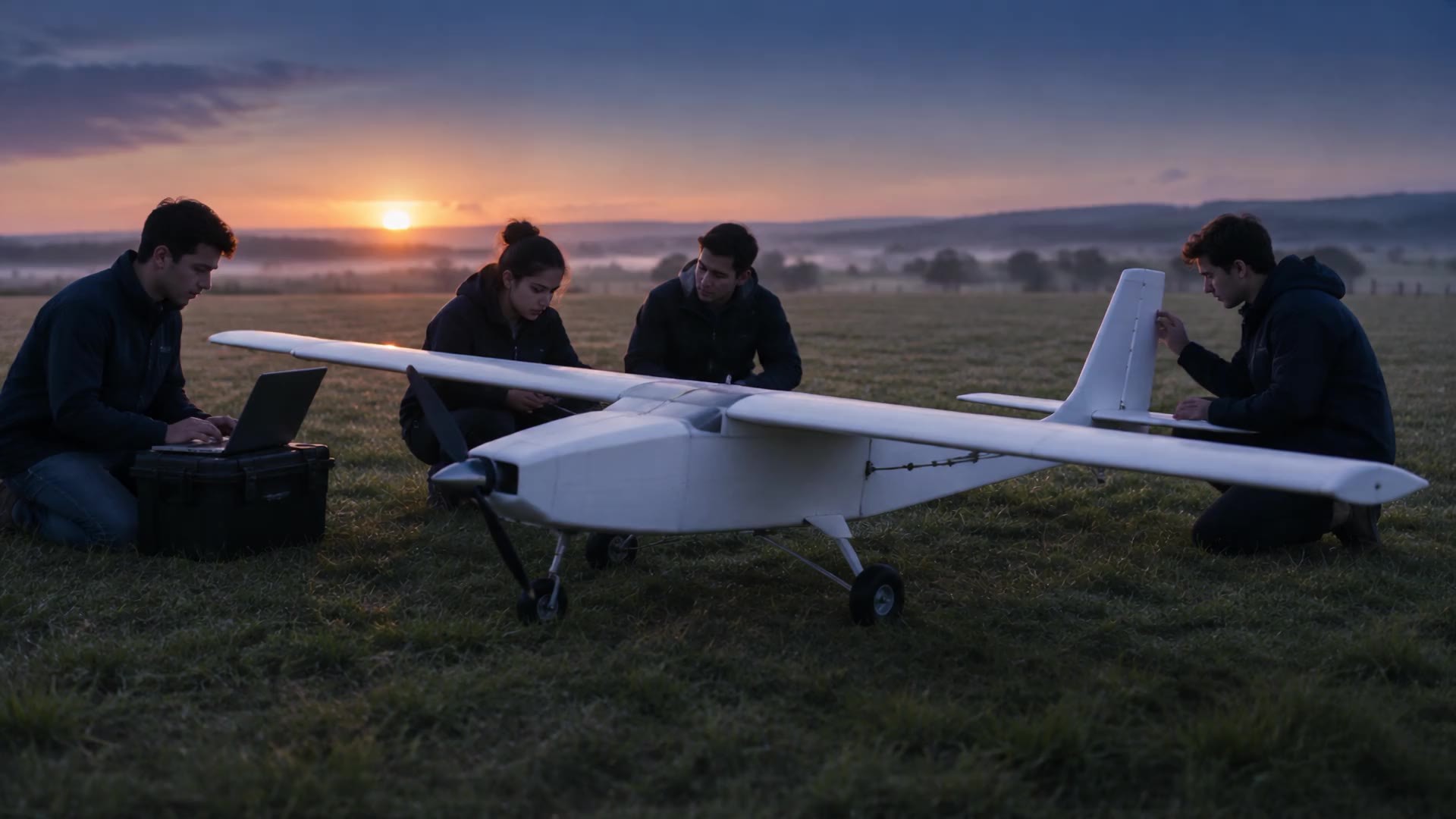
AeroDesign teams, labs, garages
From the brief
to the maiden flight.
SAE BRASIL AeroDesign 2026
Free
for your team
The competition starts on October 30. If you take part in the 2026 edition, Maiden is free for your team; professors and students start with R$ 500 in credits. Reach us on the channel you prefer: we answer in person and open your access.
Talk to us
What Maiden covers
- Wing and sections
- Tail and tail volumes
- Static stability and dynamic modes
- Stall order and minimum Reynolds number
- Trim with the payload aboard
- Control authority
Pricing
Credits, no subscription
Credits pay for the agent's and the solvers' time. Access is by invitation: you talk with us before paying anything.
-
Explore
R$97
To get a first idea off paper and see your plane's check table.
- Conversation with the agent
- Quick and full checks
- Brief, plane.toml and record
-
Recommended
Project
R$247
To take a plane from the brief to the drawing, with sweeps and negotiation.
- Everything in Explore
- Variant sweeps
- Drawing of the plane
-
Team
R$497
For teams and labs with several planes on the table.
- Everything in Project
- Several projects at once
- A direct line to us
Free for SAE BRASIL AeroDesign 2026 teams. Professors and students start with R$ 500 in credits.See how
Questions
Frequently asked questions
What does Maiden design?
It designs and checks the aerodynamics: wing, tail, control surfaces and the masses with their positions.
Do I need to know aerodynamics?
Not to start. You talk about the plane as a pilot or builder, and the agent proposes the numbers and explains each one. If you already know, go straight to requirements and sweeps.
Which methods does it use?
Vortex and panel methods for the lifting surfaces, and a viscous solver for the sections. The project names the method of each analysis: cheaper methods early, finer ones at the end.
Can I trust the numbers?
Every number comes from a derivation or a solver, or is refused with the reason. We compare the solvers with AVL and wind tunnel data to measure the differences, never to tune constants.
What do I get at the end?
The project: the plane.toml with geometry and masses, the brief, the check table and the record of every round with what was traded. A drawing of the plane when you ask.
Does it work in Portuguese?
The agent talks in Portuguese and English.
How do credits work?
They pay for the agent's and the solvers' time your project uses. Talk to us to see which pack fits your project.
How does it work for AeroDesign teams, professors and students?
AeroDesign 2026 teams use Maiden for free; professors and students start with R$ 500 in credits. Reach us on Telegram, WhatsApp, email or the form, with your team or institution. We answer in person and open your access.
Are my projects private?
Yes. Each project runs isolated on the server, and one user's agent cannot reach another user's project.
Do I need to install anything?
No. Maiden runs in the browser; the solvers run on our server.